I’m a reasonably nice, somewhat affable, yet often curmudgeonly cynic.
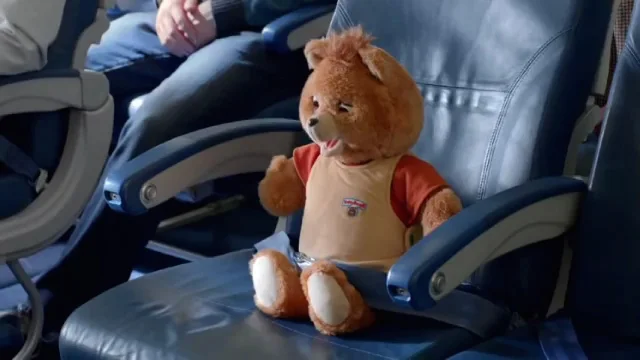
Yet, I must admit, I laughed out loud watching a Delta in-flight safety video before a recent flight to Atlanta. Ridiculous, I know. More surprising than that: I paid attention to all five-minutes-and-twenty-two seconds of the FAA mandated content. (Spoiler alert, there are floatation devices stored under your seats!!! I had no idea.)
On a typical flight, when the flight attendants are doing their pre-flight thing, I’m tuning out. I’m trying to take a nap. I’m wondering if the baby two rows up will be a cryer. I’m flipping through Skymall, checking out some ridiculous pillows. I’m doing just about anything — as long as it’s not listening to the safety briefing. Why? Because I feel I’ve heard it, I think. And while the information therein may very well save my life, it’s simply not a compelling enough reason for me to remove my headphones and look up.
But this time, I see the screen and… “what the heck is going on with that lady’s hair?” Followed by, “Holy crap, it’s Devo!”
I laughed out loud when the one dude did the worm. ALF gave me a warm fuzzy of nostalgia. Kareem was the 7’2″ cherry on top.
So what’s the take-away for us non-airline marketers? No one will pay attention to what you have to say, unless they are first paying attention to what you have to say.
Uh… did that make sense? Yup, pretty sure it did. Creativity will cut through every time.
6,000 square feet. Zero wasted space.
And not a single teller.
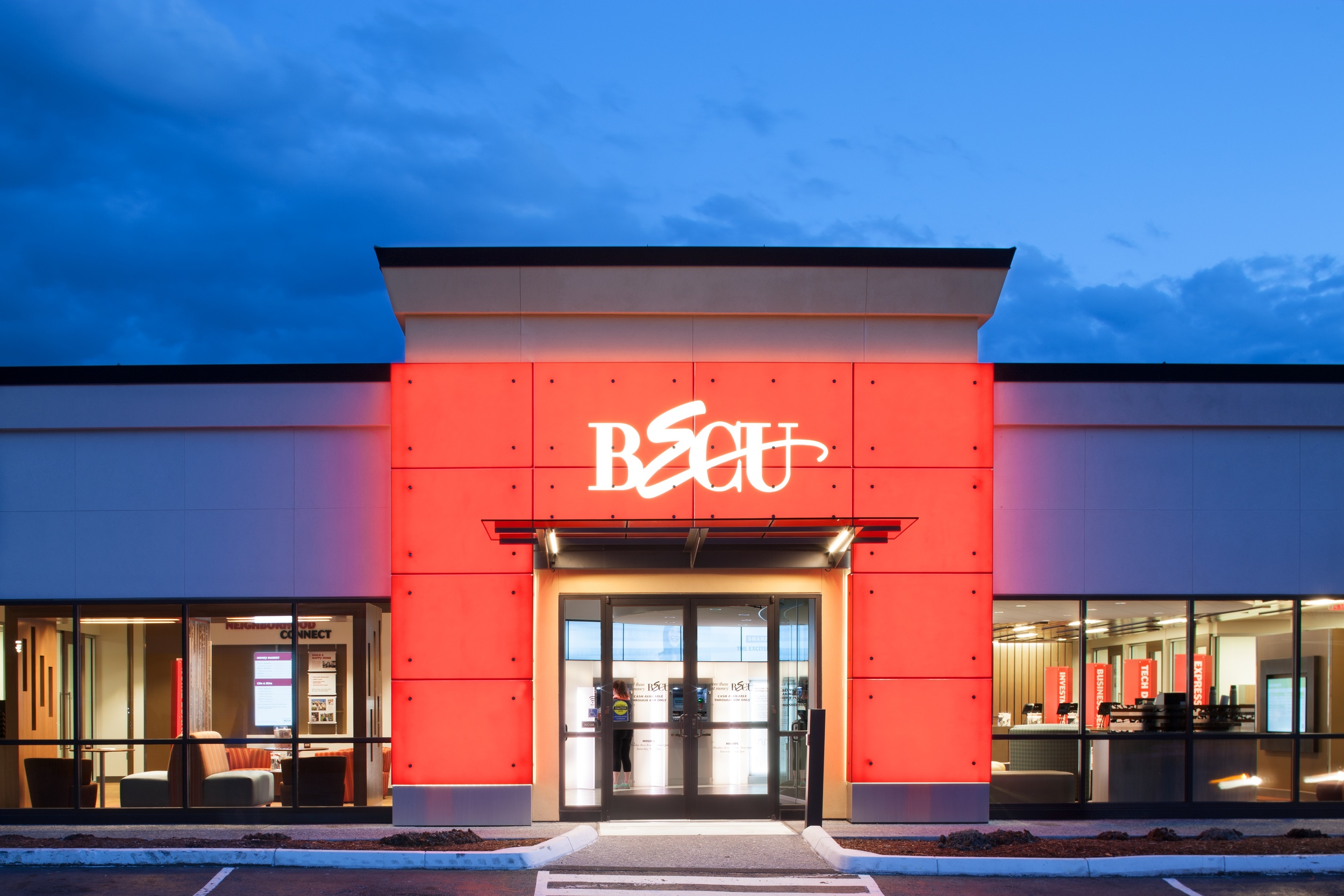
Not far from Microsoft headquarters, amid Bellevue Washington’s affluent high-tech community, BECU built a flagship branch engineered for advisory, investment, mortgage, and business services.
Beginning early 2013, Weber Marketing Group and architectural partners EHS Design, sat down with one of the country's leading credit unions, BECU. Together, we searched for answers to some challenging questions: How do we build a facility for the tech savvy Eastside community? How do we make transactions more efficient while boosting our advisory services? How do we make a statement to the Eastside that this credit union is as sophisticated in its business offerings as any local bank?
10 Months later, we had the answer. Enjoy a photo tour of BECU’s Eastside Financial Center. Together, we'll take a careful look at the spaces that make this facility so special.
Let there be light.
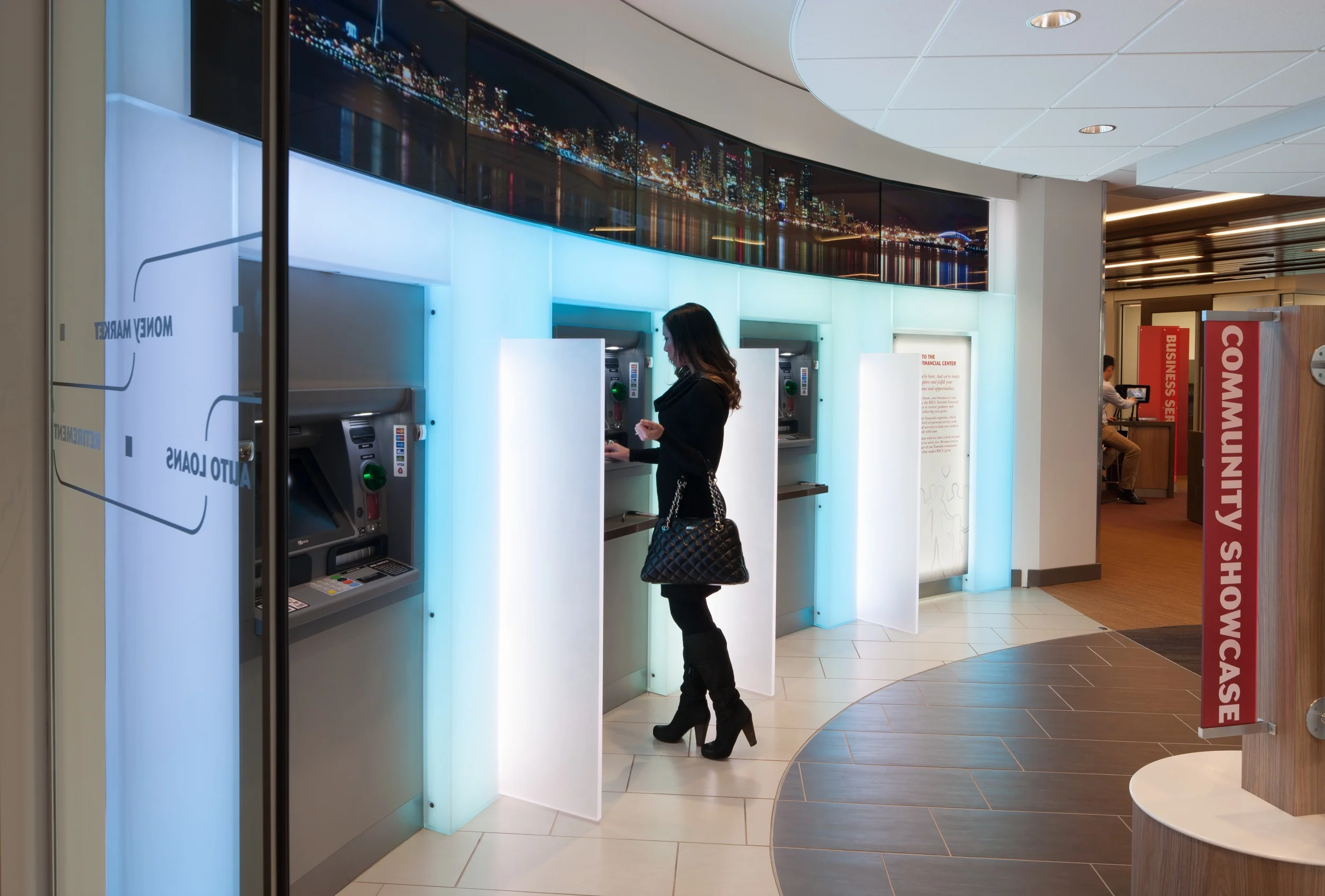
At BECU's Eastside Financial Center, the lighting draws you in. The facility is anchored by BECU's signature crimson, pops of color and light that beckon you to explore. The 24-hour smart ATM vestibule really isn't a vestibule at all. Rather, it's the first element you see when you enter a facility built for advisory services and savvy automated cash delivery.
Come inside, we’re here to serve.
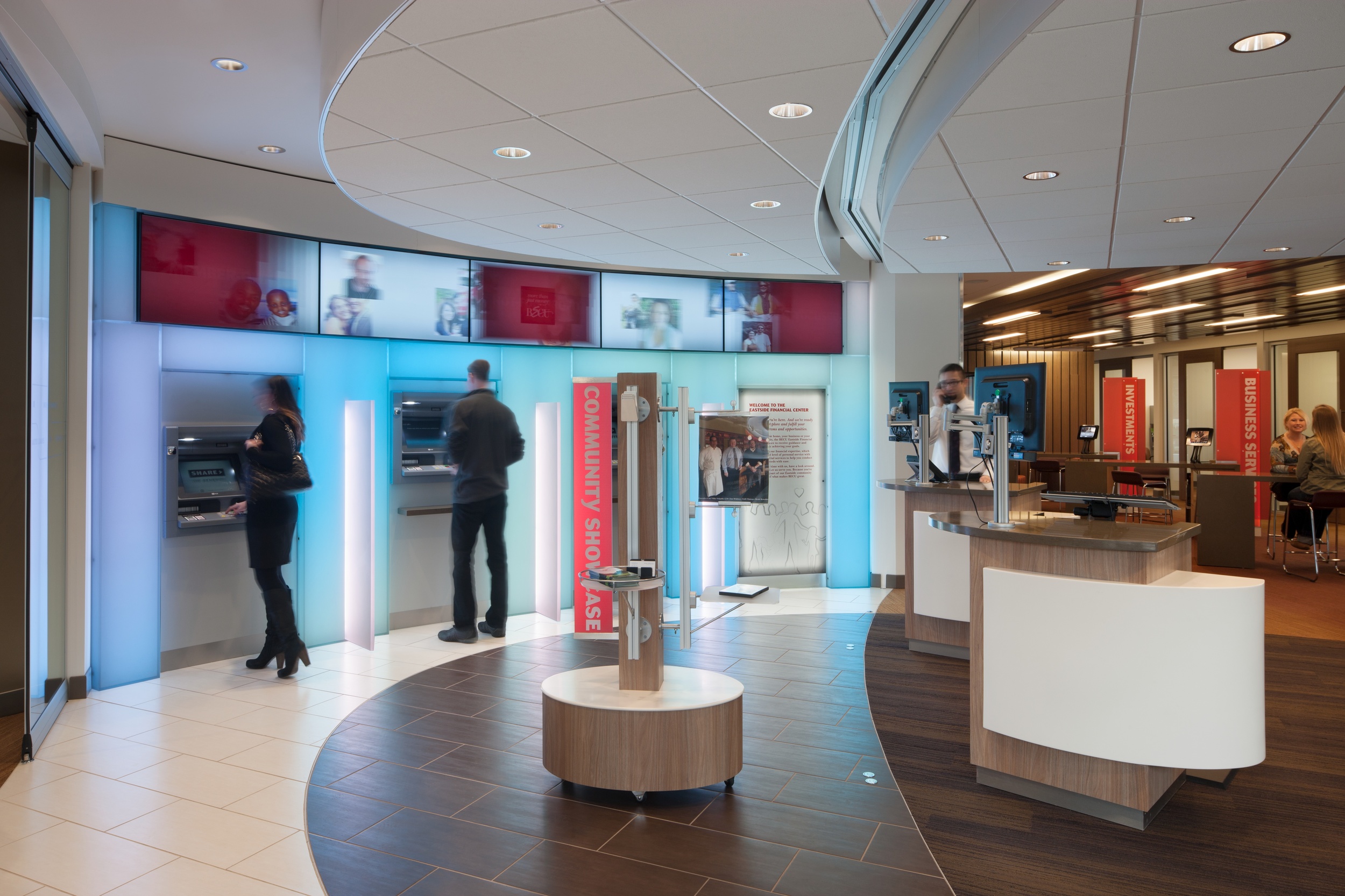
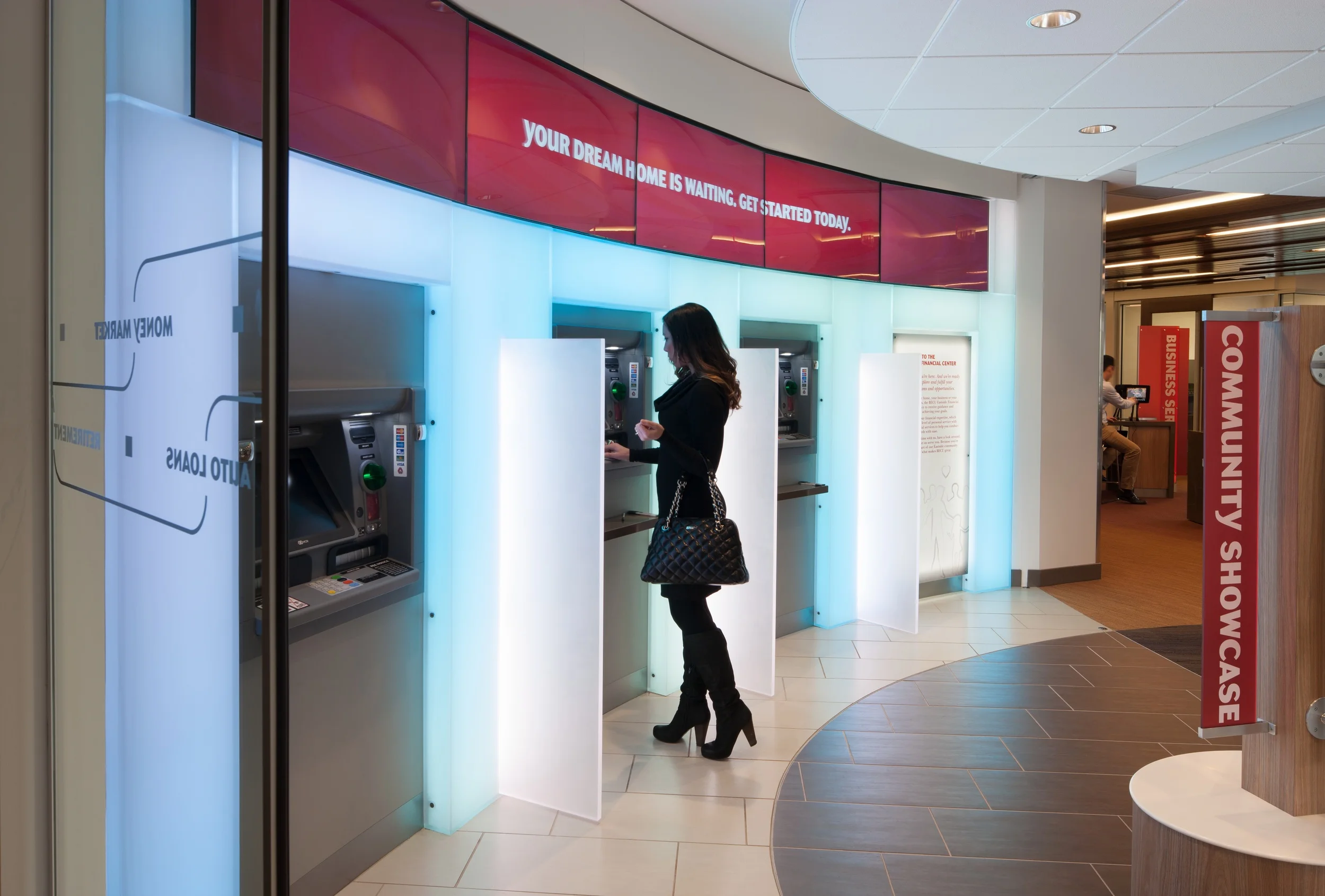
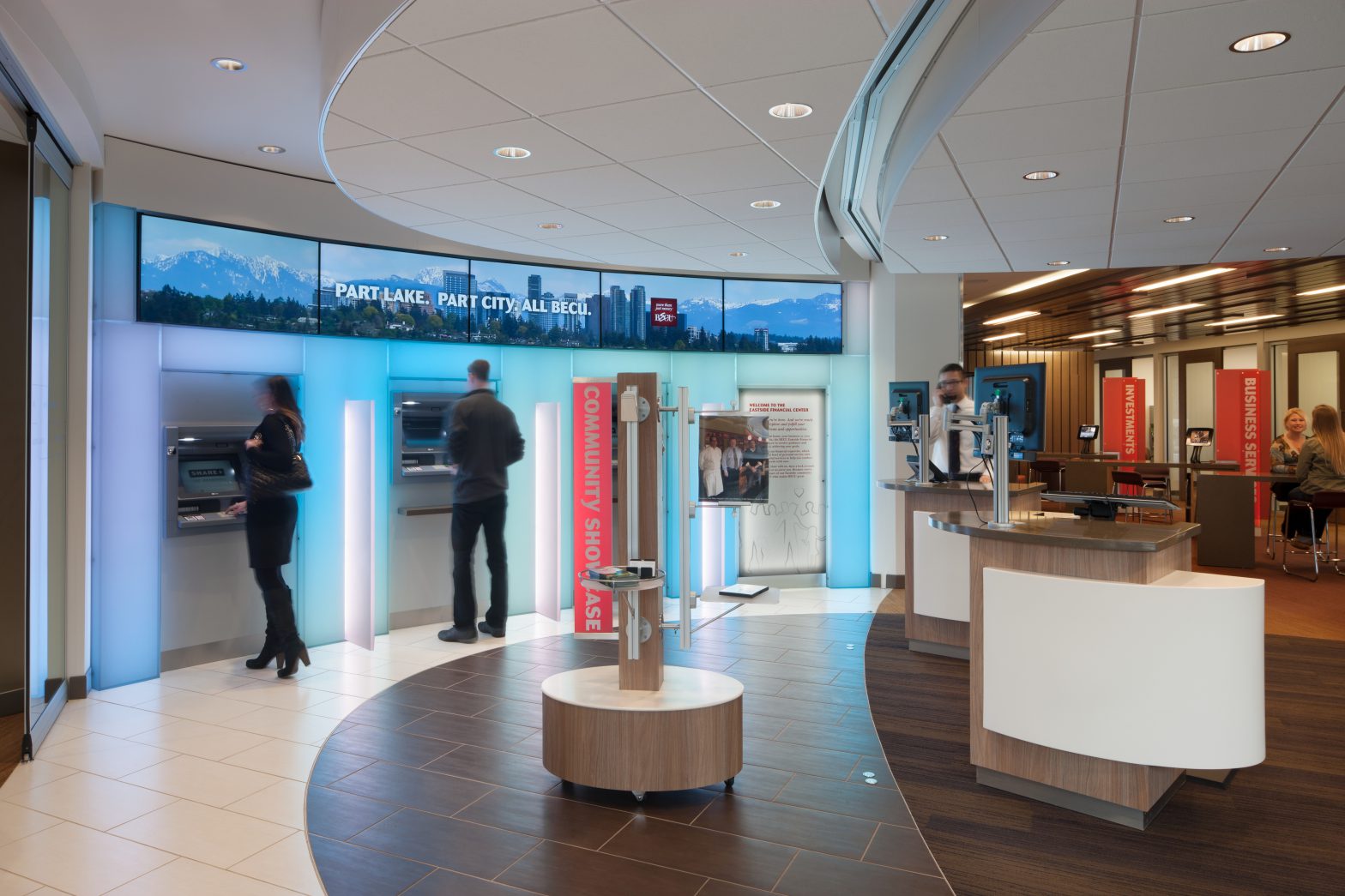
This wall of smart ATMs serves the cash-handling, deposit, and withdrawal needs of BECU members. There are no tellers here. Two senior-level concierges engage guests, guiding them to the advice and solutions they're looking for — whether loan, investment, or business related.
Simple transactions. Extraordinary impact.
The ATM wall is bathed in beautiful and ever-changing LED light. A ribbon of 5 digital monitors spans the space, showcasing dynamic motion graphic content that ranges from brand-building messaging, to gorgeous local NW scenery, to campaign promotions.
This area of the branch is open 24-hours a day. Glass "nano walls" roll out on hidden tracks, safely locking this area from other parts of the facility, creating a totally flexible space.
A transitional zone for advisory services.
Guests meet their advisors at desks, messaged to cross-sell services and demo savvy new mobile and tablet technologies. Some needs are handled almost instantly. For more detailed conversations, private offices are near by. Digital displays deliver dynamic content throughout the facility.
Flexible space is about options. And opportunity.
Informal meeting space combines with a formal conference room. Slide open the glass walls. Roll away the custom bar-height tables, and you have a community meeting and educational space ready to seat 55 guests.
The home loan center: A store within a store.
It's a Sunday morning. And this branch is closed? Or is it? Strategically placed glass nano-walls allows parts of the branch to operate on hours of its choosing. The loan center has the ability to run on its unique schedule — including being open on Sunday's to serve those who want to get their home loan finalized after visiting that perfect open house. Special staging spaces provide quick informational meetings.
Curb appeal.
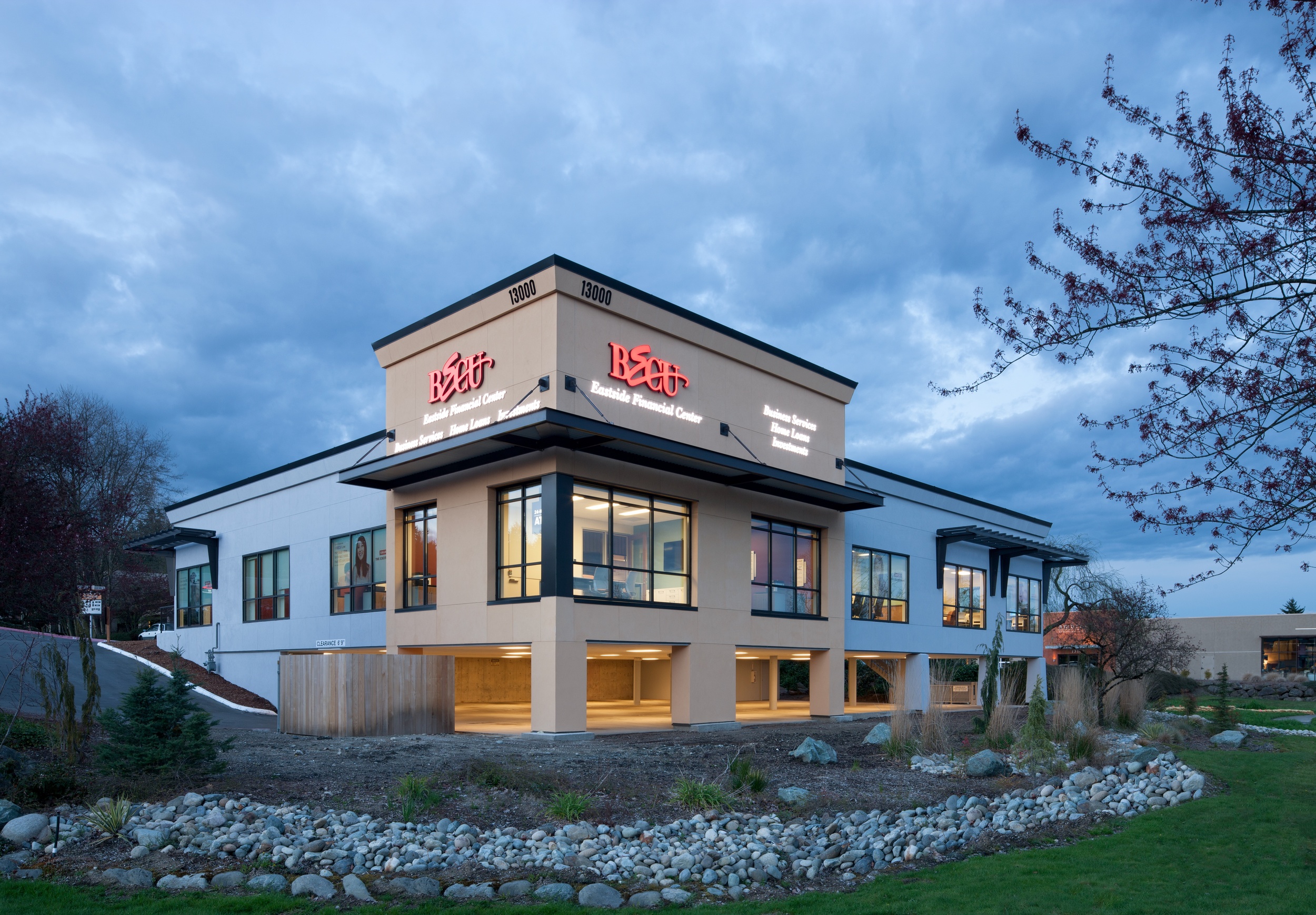
With strong curb appeal on a busy Bellevue arterial, the BECU Eastside Financial Center makes a strong statement about BECU's commitment to their members, technology, and the Eastside community. This is truly a branch of the future.
When my daughter was three I caught her jumping on her bed. When I asked her to stop jumping she replied “Dad, I’m not jumping on the bed! I’m smashing the mattress with my feet.” This was an answer I was not expecting, but I couldn’t argue with her logic. She had a different perspective, one that was arguably more creative than mine.
Everyday, Weber Marketing works with many different financial institutions with unique brands, cultures, and target markets throughout North America. Many of them have similar questions. How do we attract new customers/members? How can we better service our market? What are we not doing that we should be doing? Tackling these challenges creatively requires looking at them from a different perspective.
Kids are brilliant at looking at the world from a different perspective. They are not generally worried about providing a wrong answer, so many of them just go for it. Some answers that children give are both funny and brilliant, as this AT&T ad campaign captures.
Harnessing our inner child creativity requires acknowledging that creative challenges have more than one possible answer. So, the next time you ask a child to stop jumping on the bed, remember you may have to frame it differently. You may have to ask them to stop smashing the mattress. Maybe they could plump the cloud pillows instead.
Sometimes relying on our history can hinder our best efforts to evolve an established brand. When things aren’t going as well as we’d hoped, when we feel unsure about what to do next, we long for the days when we had momentum working in our favor. It may be tempting to emulate past successes, even though the market has changed. Even though we’ve changed. Evolution takes courage.
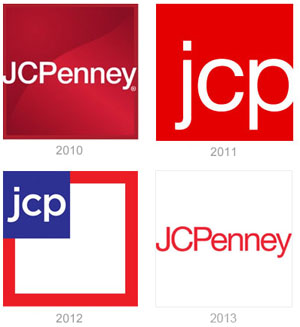
Watching JCPenney revert to its pre-2011 logo is like watching an old friend get sucked back into a relationship with the high school quarterback, the guy who still pulls up VHS tapes of past touchdowns when you drop in to say hello. This is obviously a company struggling to find a safe landing, and one that is unsure about its future.
Sure, mistakes were made. JCP’s customer base didn’t understand the hip new logo and sharply different attitude introduced in 2011. The sales strategy behind the shift aside (see John Mathes’ article titled Culture isn’t invented. It’s born.), the perception in the marketplace isn’t positive right now. It was a pretty big leap to go from a brand that appealed to my grandmother to a store I, as a mom looking for a balance of quality and affordability, might be willing to visit. While I’d never accuse this company of being careless, there are arguments to be made about what this brand did wrong, why it doesn’t feel authentic anymore, and how key transitions were missed along the way.
But the more important question may be this: was the logic behind the shift in JCP’s look and feel valid? I think it was. This was an identity that was severely dated by any measurement, one that needed to evolve.
To go back to a logo design developed in the early 70’s seems unnecessary and feels like a decision based more on fear than sound strategy. No doubt the person watching all the numbers turn red wanted to find a safe zone in manageable territory. But like the aging quarterback you should probably steer away from, the old logo represents a step back, a reliance on past successes, and a legacy that may not have enough relevance in today’s market. What’s the takeaway? This is a company in retreat. And this management team isn’t willing to take any more risks with the identity.
Rather than issuing an unflattering mea culpa and demonstrating a weakness that isn’t attractive in a brand, this company needs to instill confidence. Instead of backsliding into an old look and feel, JCP should work to change perceptions about its transformation, projecting the strength and courage required for successful reinvention. I hope this brand doesn’t give up on its quest to become more relevant and hip. Recent executions on a misguided strategy may have been wrong, but that doesn’t mean the new look and feel should be thrown out too.
enhancing culture,
engineering experiences
and growing consumers.
Let’s face it. The traditional financial services world we have known well for many years is in massive transformation.
Mark Weber, President | CEO Mark Weber is CEO of Weber Marketing Group, one of North America’s leading strategic branding agencies with offices in Seattle, Atlanta and Vancouver, BC. Weber Marketing is the winner of over 240 national marketing and brand awards.
As consumers embrace new mobile technologies, wean gradually away from branch teller transactions, and new online competitors rise up, the financial industry is rushing headfirst into a fusion of online, digital, branch and social media channels that are reshaping how we retain consumers, compete and grow.
In this new world of smart phones, tablets, Twitter and video tellers, it raises the bar even higher for how we manage our brand reputation and position our financial institutions to stand apart in a highly commoditized – and now increasingly wired financial industry.
So how do you find meaningful brand distinction and a compelling value proposition that’s unique and appealing? You start by looking inside first.
One key to helping your financial institution step to the next level of competitive external brand differentiation and healthy consumer growth is to first ensure you are defining, evolving and clearly articulating a unified brand strategy internally across your entire enterprise. Armed with a distinct and compelling value proposition and relevant messaging aligned to all your staff – it can then be linked across every physical, digital and social touch point to ensure your brand is helping you stand apart externally, while unifying cultural alignment.
Gallup researchers Jai Gill and David Helvadjian found while analyzing financial brand distinction among consumers, that “44% of all banks and financial institutions are about the same;” and only 7% believed any one bank was better. What they found that set financial institutions apart though surprised them. Put simply, they found that marketing and technology alone won’t drive meaningful distinction; it’s the consumer-facing employees who deliver the brand via consistent actions.
“Highly engaged employees drive richer, more focused consumer brand experiences.”
In our work building distinctive brand strategies among hundreds of financial institutions across the US and Canada, our agency has demonstrated repeatedly that a clear brand strategy – not a new “look and feel,” can become a catalyst of positive organizational change. It inspires a culture to deliver a unique, compelling and consistent brand promise and actions that create rich and consistent brand experiences for consumers and prospects. But transformation does not come from words, a fresh new logo, a beautiful new website or look and feel alone. It comes from intentional focus on engaging employees in shaping the future brand. From developing cross-functional engagement teams, to implementing dynamic new brand training, consistent and simple brand messaging, and rich storytelling.
Chris Catliff, CeO of $3.2 billion BlueShore Financial in north Vancouver, BC who embarked on an enterprise-wide premium brand strategy years ago shares this note, “our choreographed five-star brand experience is backed by expert financial advice and personalized, proactive solutions, delivered across all channels consistently. That includes our financial spa branches, call center, online and mobile environments which are all fully integrated.” Catliff’s proudest achievement though sums it up, “without our incredibly engaged employees, our premium brand experience and record growth could never have been achieved.” BlueShore Financial has been named one of Canada’s 10 Most Admired Corporate Cultures and achieved double- digit growth for ten straight years.
Increased staff satisfaction, an intended byproduct of reshaping internal cultural brand focus leads to higher engagement and retention – that directly hits your bottom line. national estimates from SHrM peg the cost of replacing employees at 50% – 400% of their annual salary (do the math for your organization).
“Results show how much louder actions speak in successful branding than words and pictures alone.”
This search for culture and even relevant workplace meaning has never been more important than in managing, rewarding and retaining the new generation of Millennial workers, now approaching 30-35% of the workforce. A 2013 study by Bentley University Center for Women & Business, showed that 84% of Millenials say “making a difference in the world is more important that personal recognition.” Closing the gap from “engaged employees” to brand leading, passionate, values-driven staff can lead to “brand evangelists.”
Effective branding and staff alignment also pays off in higher consumer satisfaction, nPS scores and organic growth. Highly engaged employees drive richer, more focused consumer brand experiences. They lead to increased client engagement, deeper profitable relationship building, renewed brand experiences and ultimately market share growth.
At Portland Oregon’s Trailhead Credit Union, VP of Marketing Kim Faucher shared, “we had been through brand work before but it had never captured the unique spirit of our credit union and our culture in any way that set us apart. Weber Marketing Group led the entire board, management team and our staff through a six-month strategic, cultural and creative process, conducting workshops, employee surveys and focus groups to articulate our brand and culture and explore our brand and name equity. Along the way they revealed our unique distinctiveness and discovered new opportunities where our brand could aspire and flourish.”
The leadership team wanted to build a brand that would excite employees first—a brand that would resonate as authentic and identifiable, representing something the entire staff could stand behind. The new tagline, “Small enough To Know Better,” captures Trailhead’s highly personal philosophy and lines up with their young, distinctive Portland urbanite lifestyle. The new brand bucks conformity to capture a unique and unconventional Portland vibe.
Since Trailhead’s brand launch in June 2013, the results speak for themselves. After seven+ years of no new member growth, slow loan and checking growth, the credit union has set growth records for new members (especially millennial borrowers), loans, branch and web traffic, and new checking every month since launching their new brand. This January alone, net monthly memberships compared to the year prior increased 536% from 25 to 134, lending increased 344% from $385,000 to $1,328,000 and website traffic is up 26%.
According to Trailhead’s Faucher, employee engagement, morale and pride have never been higher. A new dress code was embraced to support the brand. employees and even board members are supporting local businesses and proudly display their “be who you are tattoos.” They have turned employees into raving brand advocates and some members are close behind.
Trailhead’s new brand strategy, design and standards are clear, unique and owned by every stakeholder who lives it out every day with total consistency. One Trailhead member tweeted, “L-O-V-e the rebranding. I’m sure you will increase your membership. Smart move and investment.” results like that show how much louder actions speak in successful branding than words and pictures alone.
So how do you know if your financial institution’s brand is on target and effective, or overdue for a brand refresh or strategy update? Here are seven questions to ask how healthy your organizational brand program is today:
Are you regularly growing younger millennial consumers and borrowers who are drawn to your brand?
Do all managers and employees understand what your brand is today and how to live it out? Can they express your differentiating brand position (if you have one… do you)?
Is your name and brand awareness in the market and your image confusing, or need a boost?
Do you have strong Brand Guidelines that unify your brand promise, key messages, personality, tone of voice, style and imagery across all channels consistently?
Is there a well-defined value proposition, or relevant core values that are communicated consistently in all communications, or do you often turn to rates and low fees to stand apart?
Are your digital, online, mobile and social media strategies all growing and aligned behind a unified and well-branded consumer experience?
Do your branch interiors, products information, consumer experiences, ATM’s and digital media all express the best of your brand and online message platform?
Brand leaders challenge the status quo of their brand position constantly, instead of settling for thinking their static brand is doing fine. They know delivering “good,” or “friendly” service is not a competitive differentiator, it is simply the “table stakes” level everyone must provide. Uniting your brand and your team towards a higher brand vision and market distinction can transform your culture. Tom’s Shoes CEO Blake MyCoskie says, “I realized the importance of having a story today is what really separates companies. People don’t just wear our shoes, they tell our story.”
“It’s time to think carefully about assessing the state of your brand perceptions and strategy both internally and externally.”
The rapid shift to mobile and online virtual experiences requires careful management and evolution of your brand philosophy, but also of carefully linking your user experiences (or UX) across all channels consistently. One of our agency’s most powerful tools for shaping employee and consumer brand perceptions is engineering simpler design principles, key messaging and brand content platforms into traditional processes. We engineer transformational changes by aligning all brand experiences, design and content across channels: online (responsive web, mobile and tablet integrated user experience, or UX design); in-person (new branch model prototyping); in print (unique branded content and digital – over traditional collateral); social media (video and storytelling); and interactive media (SeO, SeM and digital campaigns). They are woven together into a seamless and unique user experience with a shared and distinctive brand personality, tone of voice and style, and then combined with personal “brand storytelling” to reshape perceptions.
Stellar brand experiences like the hospitality of the Four Seasons deliver user experiences online and in person like a symphony of musicians aligned behind a melodic musical score. no detail is missed to ensure total satisfaction of guests to win their enduring advocacy and storytelling. That brand integration occurs just as tightly behind the scenes, proactively to ensure a personalized, unique and powerful focus on each guest’s individual needs and wants.
Amidst explosive technology shifts and the rise of new financial competitors, it’s time to think carefully about assessing the state of your brand perceptions and strategy both internally and externally. Managing and evolving distinctive user experiences, improving your cultural brand focus and alignment can make the difference between who stays the course and whose brand thrives in this new digital world. Is it time to assess the state of your brand?
Twelve years of making radio: What I’ve learned, and what I like
Last week, I was in the studio producing a radio spot for our friends at Georgia United Credit Union. When we got back to the office, I went through my standard routine after every production: traffic the radio spot, archive the final, and add a copy to my iTunes library in a playlist titled “WMG Commercials”. This playlist is my personal repository of spots I’ve made over the years.
To my surprise, this modest little spot for Georgia United was my 151st (I didn’t notice when I hit 150). My how time flies.
In honor of this admittedly arbitrary milestone, I spent a few minutes reminiscing and rummaging about my archive. Below are five of my sentimental favorites over the years (I’m not saying that these are my best, or for that matter the most effective, just my sentimental favs). But before we get to the spots, I thought I’d first share a few of the things I’ve learned in my last 12 years of writing, producing, and directing radio spots.
1. Hire professional voice talent
Relatively few people make their living as professional voice actors. Those that do, tend to be awesome — and their non-union rates are about the same as anyone else. Don’t hire your niece who wants to be an actor. Avoid first-timers. Go through reputable agents and get audition demos based on your script. Did they bring something special to the part? Is their timing good? Do they sound rushed? Did they record variations? Are they improvising? Are their improvisations any good? The answers to these questions will make all the difference. Most of the hard work is done in the casting — nail it, and the rest is easier.
2. Be nice to actors and especially their agents
No one wants to work with jerks. It’s true for you. And it’s true for actors. If they like you and the project, they’ll do a better job. Ask them for their opinion on your favorite take. Listen to their suggestions. If they want to go again, let them. And make sure everyone gets paid on time. Agents are your friend — they round up the best talent they can, and ask them to burn an afternoon recording a custom demo for you. You want them to answer the phone if you call. Also, don’t beat ’em up too bad on price. Pay their asking rate as often as you can — it’s not that much — save your negotiating for when you really need it.
3. Read your scripts out loud
It should go without saying, radio is all about sound. Often, beautifully written sentences that read well on the page simply cannot be read well out loud. Use short sentences. Break up thoughts. Look for rhythm and cadence. Radio grammar is different than normal grammar. Structure your scripts so that they can be read well. Break lines if you have to. If a double spaced script can’t fit on a single page, you’re probably too long. So read your scripts out loud. Read them to someone. Time yourself. Make sure you’ve got a little buffer of time for SFX and music cues. Shoot for :55 of voice (or less) for a :60 spot.
4. Nail down your legal disclosure early
Almost all of my spots have had some sort of legal disclosure. Try to get it nailed down early. Even a brief disclosure can use up :05-:07 seconds. Some can easily top :12. Want to feature a loan rate, sweepstakes, or investment product? Depending on your client compliance folks, that disclosure could easily top :20! At that point, you have to ask whether or not the trigger (that message item that requires the legal) is worth having. Does the 1.99% auto loan rate get you anything if no one can remember the financial institution’s name because all they’re thinking about is the :30 legal disclosure?
5. Leave room for improvisation
Some of my favorite radio moments have been improv moments. Be open to it. When it happens naturally it can make a good spot great. Of course, if your spot is :03 seconds too long, there’s no room to fit in the improv. Also, how is the client with unexpected, unplanned, and unapproved change? Prep them in advance that it may be coming. Make sure that the improv doesn’t impact the legal in an unexpected way — that’s on you as the director.
6. Have fun
If you’re not having fun making radio, you’re doing it wrong — and you’ll hear it in the finished product. Of all the types of projects I work on, radio is my favorite. The projects are small and compact. You go to the studio in the morning, and by the afternoon you’re finished and drinking beer. And unlike TV (or even print work and photography), budget isn’t really a factor. Once a minimum threshold of studio time and talent is reached, there isn’t much separating your spot from a big budget spot (except, of course, the sweet molasses of Morgan Freeman’s voice).
7. Let talented people do their job
Odds are, the people you’re working with have worked on way more radio spots than you. Tell them what you’re looking for. Help them understand what you want. Then try to get out of their way. Don’t over-direct your talent. Don’t micromanage their inflections. Work with a great studio. They’ll help you turn average stuff into awesome stuff. Thank them for it. For 12 years or more, I’ve been working with Clatter & Din in Seattle. I love these guys. If another studio offered me free production for a year, I’d politely say “no thank you.” The folks at Clatter are that good. (If you’re getting ready to produce a spot, you owe it to yourself to give them a call. I promise you won’t regret it.)
Okay, that’s enough pedagogy. Here are five of my sentimental favorite radio spots.
“President Grant” (2004, Numerica Credit Union)
A senile old President thinks he invented the $50 bill.
This may be my all-time sentimental fav. This is the first spot I directed. It features the talents of the great Dave White, whom I have worked with many times since. Remember my advice on improvisation? The “should I say that” exchange at the end was all Dave’s improv. Totally unplanned. And it makes the spot.
“Metaphorical Ponies” (2008, Anchor Bank)
A giveaway promotion without a the giveaway.
I love this spot for the sheer silliness of it. I love this spot because there’s a part of me that still can’t believe that I presented this to a client. But I did. And we made it. And it actually worked. People heard it. People remembered it. And people went to the bank.
“Any Given Saturday” (2012, OnPoint Community Credit Union)
An active and diverse community is connected by a credit union.
The multi-actor spots with a lot of sound design are fun to put together. But as a writer, I’ve become more fond of well-written narration over the years. I like this spot because it does so many things at the same time: promotes Saturday hours, community connections, and a full range of services.
“Unsolicited Advice” (2013, OnPoint Community Credit Union)
Investment advice is easy to find. But good advice? That’s something else all together.
This spot is the radio counterpart to this TV commercial. And a tough assignment. We wanted to make an investment spot — which is especially hard for a credit union due to the regulation and disclosure requirements. Remember my point above about “legal triggers”? The disclosure here is more than :20 long. That’s a lot. But we decided it was worth it. I love working with actors, and this spot has a lot of them. And on the radio-geek end of things, we did a little trick with the music about half way through the legal. It sounds like it’s over and winding down, then the disclosure picks up again for another :12 or so. Amuses me every time.
A patient struggles with low self esteem, caused by her bank’s awful service.
This spot is the first one I ever wrote — and my first time in the studio as a “professional”. There’s plenty I’d do differently today. But you never forget your first time.
At first glance, disruptive innovations can be hard to get your head around. Take 3D printing. How is that possible? If I draw a ball on my computer and click print, will it come bouncing out of my HP Laserjet printer? Cool. And what about Amazon’s delivery drones? My mind goes right to small, black, ninja-like helicopters bonking their noses on my low porch overhang, dropping the Ming vase I just scored for $9.99 on eBay. How is that going to work exactly?
Understanding a disruptive innovation requires a willingness to think differently about something we’ve come to accept as normal, to see an old problem in a new way. Today, companies like Uber, Tesla, Amazon, and Umpqua are asking us to do just that, energizing outdated business and marketing models and upsetting entrenched leaders in the process. A car I can buy direct from its maker, an Internet company that delivers toothpaste before I know I need it, and a bank that wants me to drop in anytime for ice cream and a quick scan of the New York Times via iPad are examples of organizations innovating in unexpected ways, creating new markets for routine products and services that have become decidedly less gratifying over time. These companies have decided to play offense in markets where defense has become the norm.
This concept of disruption is especially compelling when it hits home. Case in point:
In Portland recently, I called for a cab. A business meeting had gone into overtime, and I was in danger of missing my flight to Seattle, a flight I needed to be on in order to pick up my kids from their after-school activities.
So I did what I imagine many people do these days: I pulled out my iPhone, googled “Portland taxi” and dialed the first reputable looking service that popped up. After requesting a large vehicle, one that could accommodate myself and four colleagues, I was told, “No problem. We’ll have someone there in 15 minutes.” Fantastic.
My co-workers and I milled around in the lobby and chatted about the meeting, and then I began to feel apprehensive. Twenty minutes had passed and no cab had arrived. I called the cab company back. “We don’t have a large car available, and we can’t promise one will be available anytime soon.” Silence. What? No apology, no problem solving, and no attempt to re-establish credibility was forthcoming.
Worry about my kids aside, I was furious. In what other industry is such rotten customer service acceptable? Certainly not in the financial services sector or the agency business. In what universe is it acceptable to simply leave a customer stranded? The cab driver that finally arrived was apologetic and drove like a maniac to get us to the airport in time and, while I sat watching crucial seconds tick by as he ran my credit card, I couldn’t fault him for the deplorable service etiquette of his dispatcher. He simply had no control or input into the situation.
Enter Uber. Had an Uber-like service been available in Portland, you can bet my experience would have been very different.
Uber is a new ride alternative that is disrupting the industry for a number of reasons. First, it’s a cashless model—you sign up for the service with a credit card when you download the mobile app to your cell phone. Your ride fee is automatically charged to your card so there’s no need to hover at the end of a ride, waiting for a slip to sign, and no worrying about figuring and adding the tip. Second, when you request a ride, you get to see how many cars are available and how close they are to your location. You can even toggle between car classes, depending on your group size (and your budget). Best, you can then track the car as it makes its way toward you.
Revolutionary. Its true that Uber is more expensive than a standard taxi service, but its also more reliable, comfortable, and efficient. Essentially, this is the anti cab.
The cab industry understandably isn’t happy about this challenge to the status quo, and resistance to Uber and others like it is playing out in courts across the country. But the industry doth protest too much, me thinks. The old system sucks. This market is ripe for disruption.
At Weber, we see resistance to disruptive innovation time and time again. Financial service retailers fight to stay somewhere between safe and static, attached to brand strategies that feel comfortable and controlled, where roles are clearly identified and variables are understood and manageable. The problem is that this space is rarely innovative—not in the least bit. And down the road, this defensive plan often leads to stalled growth and loss of market share. Maintaining momentum requires new thinking, which depends upon a willingness to see ourselves differently, to see the playing field from a new angle.
You have to play offense in order to score. And Uber is scoring big time.
(7.31.14) P.S. If you want to follow the Uber vs. Portland debate, check out this article at the Portland Business Journal : http://bit.ly/1ptyZBB
Fresh off the plane from the recent GAC show in D.C., it seems credit unions are hitting on all cylinders. And that’s definitely a good thing, as we have happily departed from those gut-wrenching recession days. There may still be a few lingering effects, but overall credit unions are starting performing well now. That said, is it time to rest on your laurels and hope to reap the rewards? Is it time to put it on cruise control and believe a river of new members will continuously flow through the door? No way.
Now’s the time to capitalize on our industry’s momentum — and nobody knows that better than Weber Marketing’s President/CEO Mark Weber. Mark will be the first to tell you that marketing is a key element in maintaining and even exceeding performance expectations when times are good. He’ll even tell you to keep the hammer down when times are bad.
Now you’re probably thinking that’s a biased message coming from an experienced marketing professional. It’s easy to go there, but Mark provides many credit union marketing success stories that keep his message objective — and on target adding proven advice for any CU looking to get a leg up on the competition.
But not everything is rainbows, sprinkles, and sunshine in the credit union marketing world. Although many industry campaigns have won awards and garnered much praise, credit unions still have a ways to go in this area — especially as marketing has become more complex today with the multiple channels that need to be covered consistently to reach a varied audience. Again, Mark provides some potent and practical advice supported by more winning examples.
We also touch on Weber Marketing’s affiliation with CUES and the upcoming Golden Mirror Awards. In addition, to help CU marketers master their skill for enhanced exposure, Weber and CUES have slated dates for their Strategic Marketing School (July 14-16, 2014) for those pros who desire the coveted Certified Strategic Marketing Executive (CSME) title.
We had quite an extensive chat with Mark, but it’s absolutely loaded with educational information anybody can use to elevate their marketing skills and knowledge. Well worth the time, so check it out!
CUbroadcast is a credit union talkshow. It is a collection of informative, online video interviews discussing today’s credit union issues and trends with some of the industry’s finest innovators, ambassadors, and game changers.
We interview industry leaders and experts nationwide from credit unions, CUSOs, vendors, regulators, league officials, media, and more. We get their take on the latest industry trends, what we can learn from the past, and how to keep this industry moving forward and better serving its millions of members now and well into the future.
Cadillac’s new ‘poolside’ ad is hard to swallow. It’s the one in which an assertive, confident master of the house surveys his domain and reminds us why Americans are so great. I’m pretty sure this is one of those ads that will reflect the worst of America’s culture when we look back on it in 50 years, and not just to the liberal idealist.
Regardless of whether the ad makes you feel proud or ugly, from a marketing perspective, I think they missed a terrific cross-promotional opportunity. To truly celebrate our culture, they should have leveraged another uniquely American campaign: Viagra.
Consider this:
First, American culture is characterized by traits like dominance, authority, power, and success. Geert Hofstede, the Dutch psychologist, professor, and former IBMer best known for his studies of national culture, describes collective US society as having a unique combination of high masculine energy and one of the most individualistic drives in the world. (Check out this tool for comparing the attributes of different countries at The Hofstede Centre website: http://geert-hofstede.com/countries.html) And the Cadillac brand, while not always relevant, exemplifies power and success.
Second, Americans are immersed in the narrative of the individual: think John Wayne and the Marlboro Man. (Note: I’d like to cite a more contemporary equivalent but that might require a separate post just to argue the merits. Who replaces John Wayne: Paul Newman? Harrison Ford? Hugh Jackman?) Internal strength and fortitude are lauded, and we admire the person who pulls himself up by his own “bootstraps,” invents his own luck, and takes care of business without bothering the rest of us. That is the American story. And that’s Viagra— because, while competitive products emphasize the relationship, Viagra is all about the man.
Third: We tend to favor short-term versus long-term gratification: think the stock market and our tendency to reward 15 seconds of fame to anyone loud, crazy, or rich enough to ask for it. We want it when we want it, which usually means now. And that consumer demand for now is in perfect alignment with premium cars and miracle drugs.
The Cadillac ad embraces all of these cultural traits, which is what makes it feel so stereotypically American. It glorifies our can do attitude and the status that comes from success. It celebrates our pugnaciousness and emphasizes our need to be on top. Which brings me to my point.
Until now, I thought one of the most illustrative examples of American culture in advertising was ‘The Age of Taking Action’ ad for Viagra. After all, what could be more emblematic of our masculine individualism than a man and his truck, solo, out on the rugged land, the picture of stoicism as he solves his own problems?
But today, I am lamenting that Cadillac and Viagra didn’t join forces to create an uber-campaign. Because the only thing missing from actor Neal McDonough’s macho assessment of what’s important in life is a shot of him swallowing a little blue pill before he gets into his elite electric car with a bit of his own electricity. Wink. What a package that would have been.
I hate buying razors, and it seems like I’m always on my last dull one. So when my wife asked me for birthday gift ideas this year, I asked for a “Dollar Shave Club” membership.
This introductory video went viral when it first came out in early 2012, and many people got a good laugh. I thought it was an interesting subscription service. Michael Dubin and his Dollar Shave Club turned a boring product (razors) with an old business model into something new – something actually convenient, affordable and even entertaining. The company targeted a specific market (men) with a new delivery method and an all-new brand to make purchasing razors fun again.
Too many credit unions and banks offer the same commoditized products, to the same audience, with the same delivery method. The Dollar Shave Club is proving that brand differentiation can set you apart, significantly changing market perception of your products and services. A razor is nothing new, yet the Dollar Shave Club has been able to make the product look new and exciting by changing the conversation and the delivery channel. With a clear strategy and understanding of the market, the Dollar Shave Club’s attention to branding is what makes this possible.
So is your brand good enough? Because, as Michael Dubin says, this brand is “f***ing great.”